NEWS16.9.2026
What Makes a Tactical Mast Sustainable? A Look Inside Mastsystem’s Responsible Manufacturing

A tactical mast is sustainable when it is light enough to move without heavy equipment, lasts long enough to be replaced rarely, needs no fluids or power to raise, and comes from a factory that measures and cuts its own energy, waste and emissions. Mastsystem’s composite tactical telescopic masts are built to that description. This article shows the evidence behind each part of it, including the parts that are still hard.
A procurement team asking a mast manufacturer about sustainability is rarely asking out of curiosity. They are asking because someone further up the chain has to evidence it: a system integrator consolidating supplier data, a ministry applying environmental award criteria, or a listed parent preparing its annual reporting. That shift is recent, and it is steep.
“Compared with 2016, the interest has multiplied. In nearly every significant project we are now asked at least about environmental matters and material compliance.”
– Petri Heikkinen, Quality and Environmental Manager
The underlying data lives on our sustainability page, including downloadable certificates.
Key takeaways
- Lighter than aluminium: glass and carbon fibre composite masts cut transport energy, install without heavy equipment, and do not corrode, so they need no protective coatings or the chemicals that go with them.
- Built to last decades: a long service life means fewer replacement products and less waste over the same mission period. This is the largest lever we control.
- No hydraulics in the field: field masts are raised by hand with a winch and belt drive, using no external electricity, hydraulic oil or compressed air. Vehicle masts are push-button, but the telescoping is still mechanical.
- A measurably lower factory load: energy efficiency measures have cut electricity use at our Joensuu factory by 25 to 30 percent in recent years.
- Managed daily, not annually: environmental and safety statistics and changes in legislation are reviewed quarterly in SHE management reviews, under a certified ISO 14001:2015 environmental management system, and our figures are consolidated into a listed group’s annual reporting.
What Defence Buyers Now Have to Evidence
Two changes have made supplier sustainability data a procurement matter rather than a marketing one.
The first is that European sustainability reporting has settled. In February 2026 the Council gave final approval to the simplification package, leaving the reporting obligation with companies that have more than 1,000 employees and more than €450 million in turnover. That covers the large integrators, primes and groups in our market. The same rules limit what those companies may ask of smaller suppliers: a reporting company can require a supplier of 1,000 employees or fewer to provide only the information marked as necessary in the voluntary SME standard, and the supplier has a statutory right to decline anything beyond it. The questionnaire that lands on a supplier should now be a defined one rather than an open one.
The second is that defence is being simplified alongside the rest, not exempted from the subject. The Commission’s Defence Readiness Omnibus, presented in June 2025 and still working through the legislative procedure, would let defence readiness projects use existing derogations in environmental and chemicals law, and it arrived with guidance on how sustainability due diligence applies to the defence sector. For a supplier the direction is clarification rather than disappearance. Environmental performance sits alongside export control compliance and security of supply as something a defence supplier is expected to be able to evidence.
For a mast supplier that comes down to three practical asks: a certified environmental management system that an external body audits, an operational carbon figure with a stated boundary, and a code of conduct that covers the supply chain. We hold all three. Because Mastsystem has been part of the Swedish Lagercrantz Group since 2024, our figures are consolidated into a listed group’s annual integrated sustainability report rather than sitting in a PDF of our own making.
Sustainability Starts With Product Design
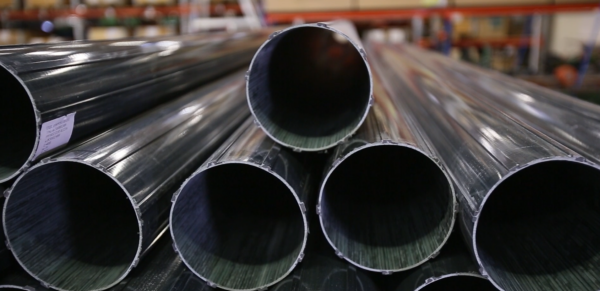
Defence buyers judge field equipment on whether it survives harsh conditions for years without failing. They increasingly judge suppliers on environmental responsibility as well. Those two pressures point the same way. Equipment that is durable, light and simple to transport is usually also the more sustainable choice, because it consumes fewer resources across its life. The largest environmental gains are therefore designed in long before a mast leaves the factory. Four decisions do most of the work.
Composite Materials Instead of Aluminium
We manufacture our masts from glass and carbon fibre composite, which gives equivalent structural performance to aluminium at significantly lower weight. The lower weight reduces transport energy and allows installation without heavy lifting equipment. Composite also does not corrode, which removes the need for protective coatings and the chemicals that go with them, along with the recoating cycle over the mast’s life. We set out the full engineering picture in our comparison of composite and aluminium masts.
A Service Life Measured in Decades

Our composite masts are engineered for decades of reliable field operation without significant performance degradation. The arithmetic is simple. A mast that serves thirty years is one manufacturing event and one disposal event. Three masts that each last ten years are three of each, plus the transport in between. Everything else in this article is smaller than that difference. It is also what Made to Stand means in practice: a mast that outlasts several generations of the equipment mounted on it. There is more in our article on the long service life of tactical masts.
Mechanical Elevation With No Hydraulics
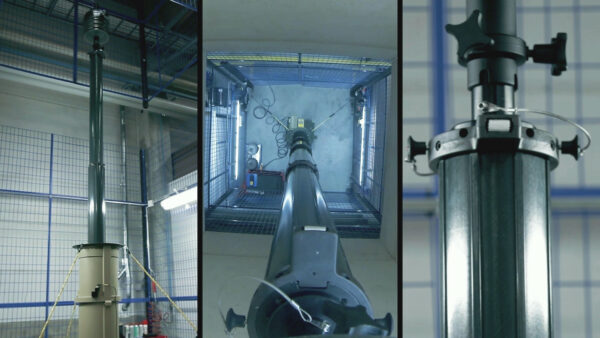
Our field masts, from the TM-mast to the EXL-mast, are raised by hand with a winch and belt drive or pushed up section by section and locked mechanically. No external electricity, hydraulic oil or compressed air is involved. Removing hydraulics removes the risk of oil leaking into the ground at the deployment site, and it removes a maintenance stream of fluids, seals and disposal. It also has an operational side: a manual winch works during a power outage and in silent running, when a generator is not an option.
Our vehicle masts, the push-button EXB-mast and the computer-controlled SkyHigh, are raised at the push of a button rather than by hand, but the telescoping is still mechanical. No mast in our range uses a hydraulic or pneumatic system.
Compact Telescopic Transport
A telescopic mast collapses into a compact form for transport. That reduces the volume required for logistics, which lowers the fuel and emissions tied to moving equipment to where it is needed. On a container or vehicle load the saving compounds across every unit shipped.
Composite Versus Aluminium: The Honest Comparison
Composite wins most of the sustainability comparison. It does not win all of it.
| Composite (glass and carbon fibre) | Aluminium | |
|---|---|---|
| Weight for equivalent structural performance | Significantly lighter | Heavier |
| Corrosion | Does not corrode, no coatings or associated chemicals | Corrodes in salt and industrial atmospheres, needs coating or anodising |
| Maintenance across service life | Minimal, no recoating cycle | Coating inspection and repair |
| Service life in field conditions | Decades without significant degradation | Depends on coating condition; corrosion shortens it in salt and humid environments |
| Transport footprint | Lower weight and collapsed form reduce fuel per unit moved | Higher weight per unit moved |
| End of life | Harder. Grinding and cement co-processing available, no scrap value | Clear advantage. Recycles repeatedly with high material recovery and real scrap value |
What Happens at End of Life
Aluminium has the better end of life story and there is no point pretending otherwise. It has an established scrap value, it recycles repeatedly with high material recovery, and the infrastructure to do it exists in every industrial economy. Composite has none of those things to the same degree.
What composite does have is a set of routes that have matured considerably, largely because the wind industry has spent a decade solving the same problem at a much larger scale. Three are relevant to a mast:
- Mechanical processing. Composite is shredded and ground into filler for construction products and new mouldings. Processors handle this commercially in Europe today, including in Finland.
- Cement co-processing. The organic fraction substitutes for fossil fuel in the kiln while the glass fibre and filler content substitutes for mineral raw material in the clinker. Industry figures put the saving at up to one tonne of CO₂ per tonne of composite waste compared with incineration. The route is technically and commercially proven, though the European industry is still asking regulators to classify it formally as recycling rather than recovery.
- Fibre recovery. Pyrolysis and solvolysis recover carbon fibre for reuse in new composites. This is commercially real for carbon fibre and still developing for glass.
A mast is also not a monolith. The tube sections are composite, but the fittings, hardware, guy assemblies and fasteners are metal and separate cleanly into conventional recycling at decommissioning.
Our position is that the lever we control is the first one, not the last one. We cannot make composite recycle like aluminium. We can build a mast that only needs to reach end of life once in thirty years.
The Hardest Question We Get Asked
“The hardest question we have been asked is whether we can prove the origin of our materials through the entire supply chain. A manufacturer depends on the information its suppliers provide, and the further down the chain you go, the harder that information is to verify in practice.”
– Petri Heikkinen, Quality and Environmental Manager
That is worth stating plainly, because the alternative is to imply a certainty that a multi-tier supply chain does not allow. What a manufacturer can do is shorten the chain and then check it.
Our supply chain is heavily weighted towards domestic procurement. A significant proportion of our components and services are sourced from Finland, and many of our key suppliers sit on the same industrial estate in Joensuu, next door to our factory. A short chain is not only a transport argument. It is a traceability argument, with fewer links and suppliers we can walk into rather than survey by email, and it is a security of supply argument, which for a defence buyer often matters more than either.
New suppliers provide baseline environmental information through our supplier assessment form, and we run supplier audits as needed, covering quality, environmental and certification topics. What those audits look for is not paperwork.
“The first thing I look at is whether the documents match the practice. Certificates and written procedures matter, but what interests me is whether you can see them in the production and in the way people work.”
– Petri Heikkinen, Quality and Environmental Manager
It is the same test we would expect a customer to apply to us.
Energy and Emissions in Our Finnish Factory

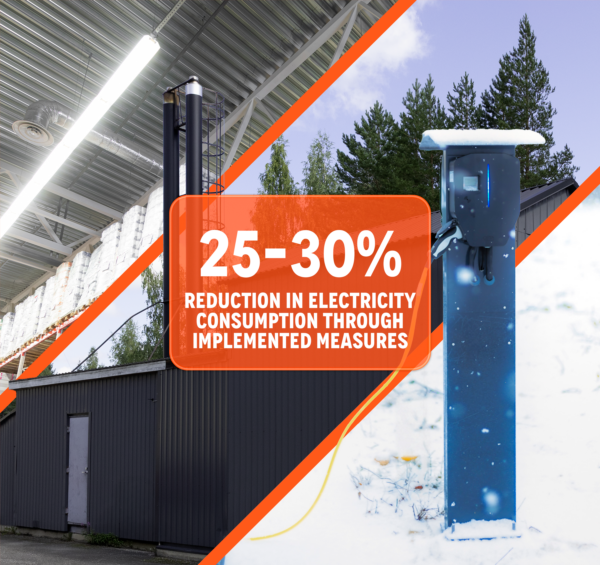
Inside the factory we have invested in a series of practical measures to cut energy use:
- Pellet heating: we are replacing oil based heating with a renewable pellet solution, directly reducing our Scope 1 emissions.
- LED lighting: all production facility lighting has been converted to energy efficient LED technology.
- Building automation: heating and ventilation controls have been modernised to optimise energy use.
- Compressed air optimisation: the compressor has been replaced and its usage optimised to reduce electricity consumption.
- EV charging: six charging stations have been installed at the factory for employee use.
Together these measures have reduced our electricity consumption by 25 to 30 percent. Electricity, pellet and oil consumption are reported quarterly in our SHE (safety, health, environment) management reviews, which is what stops this from becoming a one off project.
Measuring and Reducing Our Carbon Footprint
Responsible claims start with measurement. Our operational carbon footprint is approximately 864 tonnes of CO₂.
The majority of our total emissions arise in the supply chain rather than in our own operations, which takes sustained effort rather than a single fix. That split is also why we are careful about how factory figures get used.
“All sustainability actions are important, but sometimes discussions place too much emphasis on the impact of individual countries and too little on the whole picture. Sustainability problems are global, so solutions should be judged by their real worldwide effect.”
– Petri Heikkinen, Quality and Environmental Manager
Applied to a mast, the honest comparison is not between two factory numbers. It is between two products across thirty years of service: what they weigh in transport, how often they are replaced, what has to be applied to them to keep them working, and what is left at the end.
Waste Reduction and the Circular Economy
Production waste is sorted and recycled as efficiently as possible, and we have steadily improved our sorting in recent years. One practical example: we acquired a cardboard perforator that turns cardboard waste into a mesh like packaging material, which reduces our use of cushioning plastic.
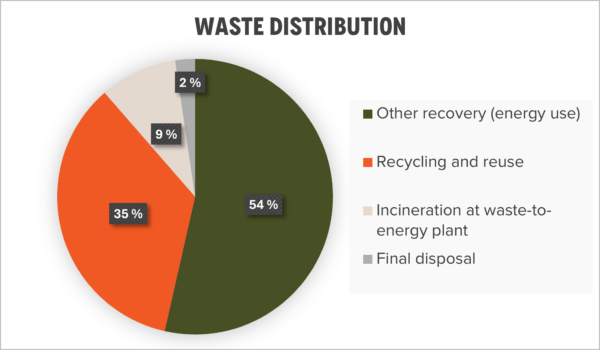
Our waste stream is divided into energy fractions and wood used as energy fuel, recyclable materials, mixed waste sent for incineration, and fractions requiring final treatment such as paint waste. Waste data is collected in partnership with our waste management provider, so the figures are based on real measurement rather than estimates.
The Number We Watch Most Closely
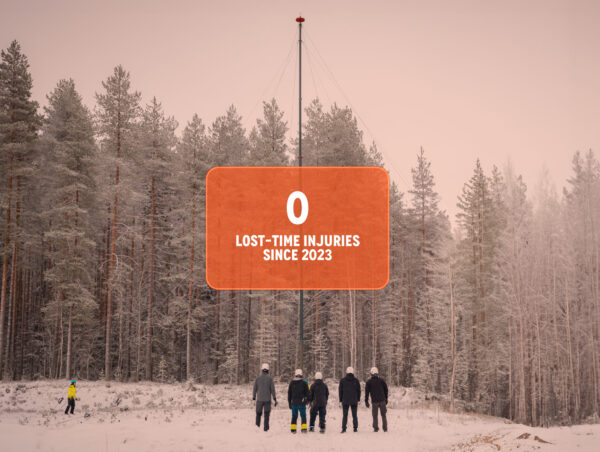
Our target is zero lost time injuries and we have recorded none since 2023. The figure that gets the most attention internally is the one that comes before an injury.
“The numbers we watch most closely in management reviews are lost time injuries and near miss reports. If those move in the right direction, it usually tells you that management, the working environment and the safety culture are all working. They are concrete measures, and they show the effect of responsible operation directly in people’s everyday work.”
– Petri Heikkinen, Quality and Environmental Manager
Near miss reporting is a culture measure as much as a safety measure, because it only produces useful data if people are willing to file the reports. Safety is managed by a dedicated safety organisation responsible for instructions, induction and supervision, while line management holds day to day responsibility with support from specialist functions.
Safety statistics are reviewed in the same quarterly SHE management reviews as our environmental data. That is deliberate. They are treated as one subject rather than two.
Responsibility as Daily Management
Asked what has changed most at Mastsystem, Petri does not name a piece of equipment.
“The most significant step has been making responsibility part of daily management and measurement. Instead of environmental targets on their own, we systematically follow safety, environmental indicators, changes in legislation and development actions in management reviews.”
– Petri Heikkinen, Quality and Environmental Manager
In practice the quarterly SHE management review is not only an environmental review. It covers safety statistics, energy and waste figures, changes in legislation and the status of development actions in one place, which is what keeps energy work, waste handling and safety culture moving at the same time rather than in turns. The concrete results have been the energy measures above, the improvements in waste handling, and a steadily stronger safety culture.
The systems underneath are externally audited:
- ISO 14001:2015, the international standard for environmental management.
- ISO 9001:2015, the international standard for quality management.
- AQAP 2110:2016, the NATO quality assurance standard for defence suppliers.


All three certificates are available for download above and on our sustainability page, which is usually the fastest way to close out a supplier questionnaire.
Mastsystem has been part of the Swedish Lagercrantz Group since 2024 and operates independently under its own name. As a Group company we follow the Lagercrantz Code of Conduct, which covers environmental responsibility, human rights and business ethics, and the Group publishes an annual integrated sustainability report. You can learn more about the company on our About Us page.
Responsible Manufacturing You Can Verify
Sustainability, for us, is consistent action and honest measurement rather than slogans. We commit only to what we do, we measure the results, and where the answer is inconvenient, as it is at end of life and deep in the supply chain, we would rather write it down than leave it out.
The certificates that answer most supplier questionnaires are on our sustainability page. If you want to go further than the documents, apply the test Petri applies to our own suppliers and check whether they match the practice. Get in touch with our team or look at our tactical telescopic mast systems.
Frequently Asked Questions
Can Mastsystem prove the origin of its materials throughout the supply chain?
Not with absolute certainty. Any manufacturer that depends on a multi-tier supply chain faces the same limit: we rely on the information our suppliers provide, and the further down the chain you go, the harder that information is to verify in practice. What we do is keep the chain short and check it. A large share of our components and services is sourced in Finland, many key suppliers are on the same industrial estate as our factory, new suppliers complete an environmental assessment form, and we audit suppliers as needed on quality, environmental and certification matters.
Are composite masts more sustainable than aluminium masts?
In most respects, yes, with one honest exception. Glass and carbon fibre composite gives equivalent structural performance to aluminium at significantly lower weight, which lowers transport energy and allows installation without heavy equipment, and it does not corrode, so it needs no protective coatings or the chemicals that go with them. Aluminium is the better material at end of life, because it recycles repeatedly with high material recovery and a real scrap value. Across a full service life the weight, coating and longevity advantages of composite outweigh that, but the recycling difference is real. See our full composite versus aluminium comparison.
What happens to a composite mast at the end of its service life?
The metal fittings, hardware and fasteners separate into conventional metal recycling. The composite tube sections go to mechanical processing, where they are ground into filler for construction products, or to cement co-processing, where the organic fraction substitutes for fossil fuel in the kiln and the mineral content substitutes for raw material. Both routes operate commercially in Europe. Fibre recovery by pyrolysis is available for carbon fibre and still developing for glass.
Is Mastsystem ISO 14001 certified?
Yes. Mastsystem Int’l Oy holds a certified ISO 14001:2015 environmental management system, audited by an external body. We also hold ISO 9001:2015 for quality management and AQAP 2110:2016, the NATO quality assurance standard for defence suppliers. All three certificates are downloadable.
What is Mastsystem’s carbon footprint?
Our operational carbon footprint is approximately 864 tonnes of CO₂. The majority of our total emissions arise in the supply chain, which we work to reduce through local sourcing and supplier assessment. Our move from oil to renewable pellet heating reduces our direct emissions.
How does a long service life make a tactical mast more sustainable?
A mast that performs reliably for decades is replaced far less often. One mast serving thirty years means one manufacturing event and one disposal event, against three of each for masts that last ten years. Fewer replacements mean less raw material, less manufacturing and less waste across the same mission period, which is why durability sits at the centre of our design work.
Do Mastsystem masts use hydraulic systems?
No. Our field masts are raised by hand with a winch and belt drive or pushed up and locked mechanically, using no external electricity, hydraulic oil or compressed air. Our vehicle masts are push-button, but the telescoping is still mechanical. No mast in our range uses a hydraulic or pneumatic system, which removes the risk of hydraulic oil leaking into the environment.
What sustainability documentation can Mastsystem provide to a procurement team?
ISO 14001:2015, ISO 9001:2015 and AQAP 2110:2016 certificates are downloadable from our sustainability page. We can also provide our operational carbon figure, our supplier assessment approach, and the Lagercrantz Group Code of Conduct and annual integrated sustainability report, which consolidates our data as part of a listed group.
Where are Mastsystem’s tactical masts made?
All of our tactical telescopic masts are designed and manufactured at our own factory in Heinävaara, in the Joensuu region of eastern Finland, supported by a supply chain weighted heavily towards Finnish suppliers, many of them located on the same industrial estate.
MADE TO STAND
Stay updated through our social media channels:


Contact us: mastsystem contact information | Mastsystem
