NEWS5.3.2026
Tactical Mast Systems and limited signature IR Light: How to Conceal a Forward Operating Base
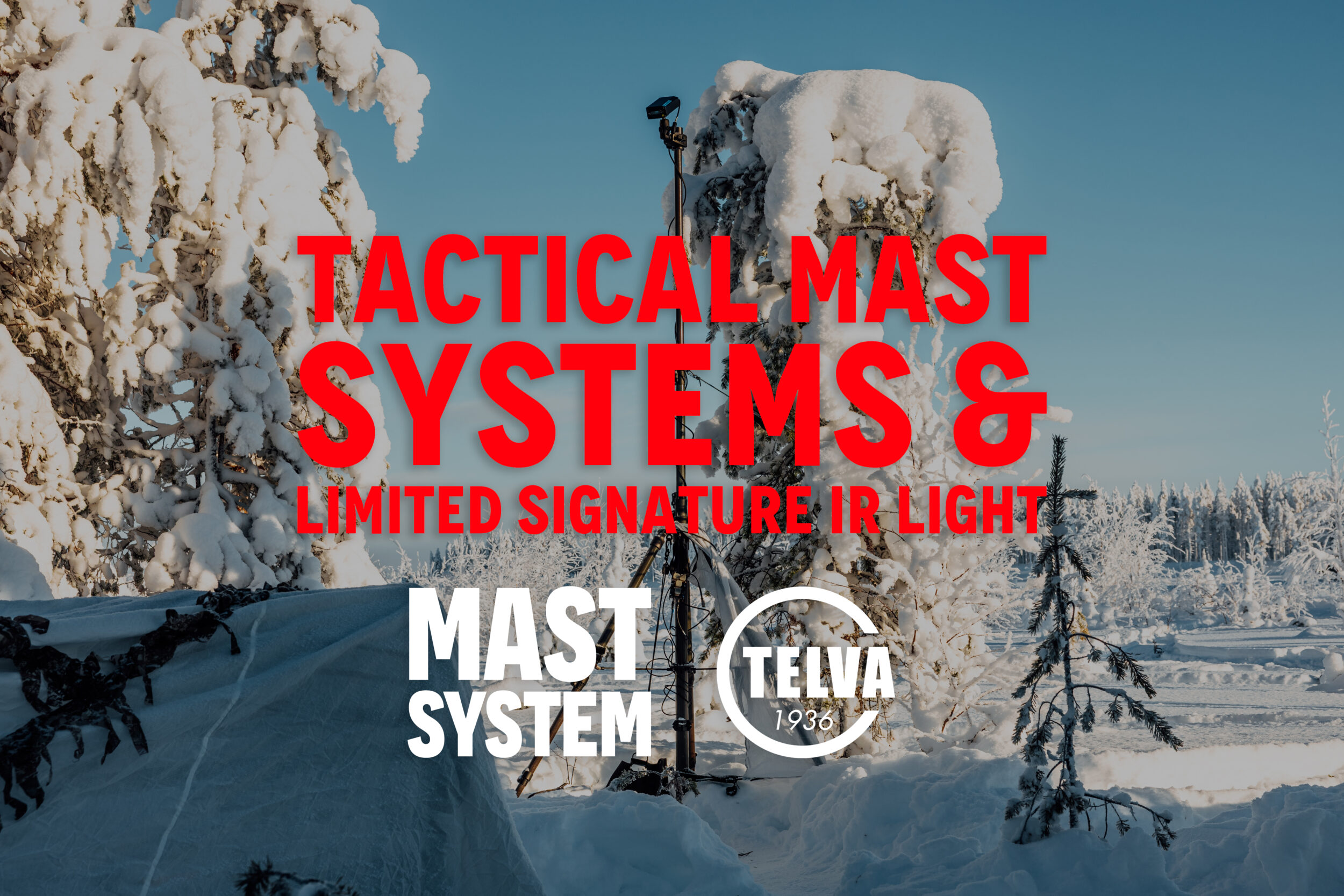
Mastsystem at Griffin Tech Days 2026 — tactical mast systems field-tested at −30°C in Lapland, Finland.
Case Study
The problem: light gets you killed
IR signature management at forward operating bases is no longer a niche concern—it is the most immediate survivability problem for ground forces. There is no safe rear area anymore. Ukraine has made that clear. Any detectable emission (thermal, electromagnetic, optical) is found and struck. As a result, Strike drones now account for up to 80% of personnel casualties. Every forward operating base, logistics hub and staging area must assume it is being watched.
The IR domain is the most immediate headache for ground forces. A standard IR illuminator allows you to work at night. However, it also broadcasts your position to anyone with night vision — often at several kilometres. NVGs and FPV drones with thermal cameras are now everywhere on both sides. As a result, any uncontrolled IR signature — whether NIR or thermal — becomes a targeting beacon.
This is not a hypothetical. For example, night vision devices were once exclusive to a handful of advanced militaries. Now they are all over the battlespace. In addition, the adaptation cycle has compressed to weeks—deploy a new countermeasure and expect the sensor response almost immediately.
The bind is obvious: forces need darkness to survive, but darkness requires light, and light creates signatures that draws fire. Thermal concealment suppresses thermal emissions by up to 96%. Still, that does not help if optical IR (NIR) emissions give the position away at the same time. What is missing is a third option: illumination that works at close range but stays invisible at any distance that counts.
Griffin Tech Days 2026: testing in the Arctic

Griffin Tech Days (GTD) was a technology experimentation event run by the Finnish Defence Forces near Kemijärvi in Lapland, Finland. It was not a traditional trade fair. Technologies, including military mast systems, surveillance equipment, and drone countermeasures, were tested in real field conditions, not in simulation.
The temperatures plummeted to −30°C. Everything had to work in ice, deep snow, and extreme cold. The organisers designed GTD to separate what works from what only works in a brochure.
What we demonstrated: tactical mast systems and IR concealment
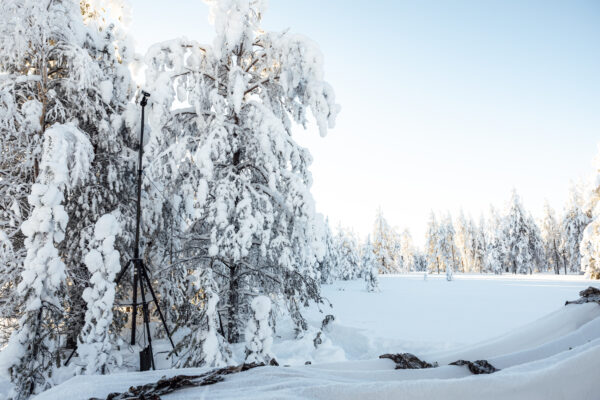
The demonstration featured Mastsystem one of seven participating companies, under the coordination of Telva Oy, defence company based in Helsinki. The group integrated tactical mast systems with limited signature IR technology. Together, they demonstrated a complete concealed base concept.
Participating companies
- Telva (Obsidian limited signature IR light)
- Mastsystem (tactical tripod mast systems)
- Ghosthood (thermal concealment)
- BRP Finland (snowmobiles)
- Canon Nordic (full-spectrum camera)
- Senop (night vision devices and thermal camera)
- CPE Production (operator helmet)
Obsidian: limited signature IR light
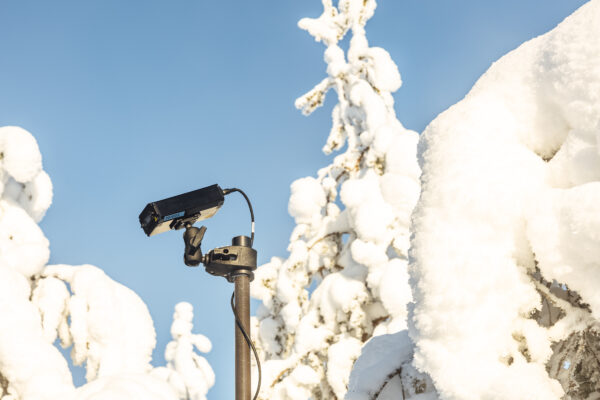
Obsidian is a military-grade limited signature infrared light made by Telva, launched in August 2023. It addresses the IR problem directly: sufficient illumination for close-range work (driving, base setup, maintenance) while staying undetectable at distances that matter. Through NVGs, its detection threshold is around 300 metres*. Within that, it illuminates a working area up to 50 metres. In contrast, a conventional IR light is easily visible through NVGs over several kilometres. The difference is significant—an order of magnitude or more.
intended end users include special operations forces, armoured units, logistics and engineer units, and artillery and air defence—anyone who needs to move, build, or work at night without giving away their location. Telva distributes its products across Europe through their partners in Poland, Germany, Benelux, Norway and Denmark.
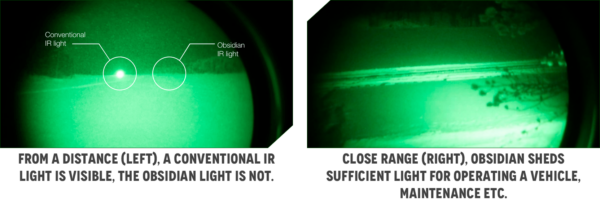
Every aspect of the concealed base concept hinges on one critical factor—freedom to assemble the light sources in locations that provide efficient illumination but limited signature. Elevation is essential—without it, the physics do not work. That is why Mastsystem’s role was not merely supportive; it was foundational.
*Subject to surrounding conditions, light settings, angle of view etc.
Tactical mast systems in action: the TM58 elevated platform
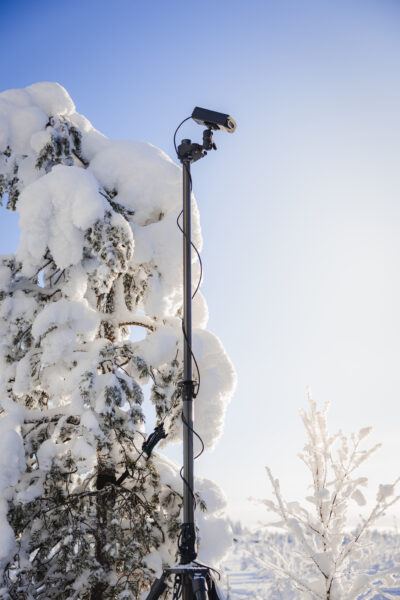
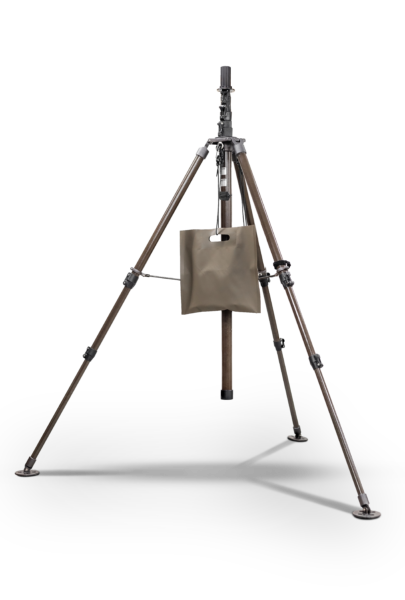
Mastsystem provided two TM58 telescopic tripod masts, extended to approximately 4–6 metres, with Obsidian lights mounted on top. Specifically, the TM58 is a glass fibre composite tripod mast rated for up to 6 metres deployment height with a 5 kg vertical top load—enough for a mounted IR light, sensor, or antenna. The complete system weighs just 11 kg (plus 3 kg of accessories), packs down to 1.7 metres for transport, and deploys in minutes using telescopic sections locked with mechanical latches.
No external power, no vehicle, no tools. The TM58 is designed to operate reliably from −40°C to +55°C, which mattered at GTD’s −30°C.
These tactical mast systems serve as elevated platforms for the Obsidian lights, and elevation matters tactically. Think about it from a geometry standpoint. Raising the light to 4–6 metres gives uniform area coverage. It eliminates ground-level shadows that complicate close-range work. It also optimises the emission angle, so a single source covers the entire working area while staying invisible at distance.
A ground-mounted light covering the same area needs either higher output power, which risks increasing the detection signature, or multiple units spread across the area, each one a separate signature risk. One limited signature light on a single mast solves both problems: better coverage and fewer detectable emission points. In signature management, fewer sources at lower power are the goal, not a compromise. As a result, the mast makes the concept achievable.
Tripod mast range: configurations from 1.6 to 6 metres
Mastsystem’s tripod mast line covers heights from 1.6 to 6 metres and top loads from 5 to 30 kg, all in man-portable glass fibre composite construction. The lighter TP44 tripod models handle up to 30 kg at heights up to 3 metres, suitable for heavier narrow-beam antennas or sensors like Saab’s Sirius Compact system, which Saab already deploys on Mastsystem tripods.
For the GTD concealed base application, the TM58’s 6-metre reach was the right choice: enough height for effective light distribution, light weight for two operators to carry and set up in deep snow wearing thick Arctic gloves.
The tripod configuration deploys and repositions fast without vehicle support. In practice, this was not a theoretical advantage, operators moved and redeployed the masts during the demonstration sequence in real Arctic conditions, proving the rapid-deployment capability that Mastsystem has built over 40 years and having delivered so far close to 40,000 delivered mast systems worldwide.
The demonstration sequence
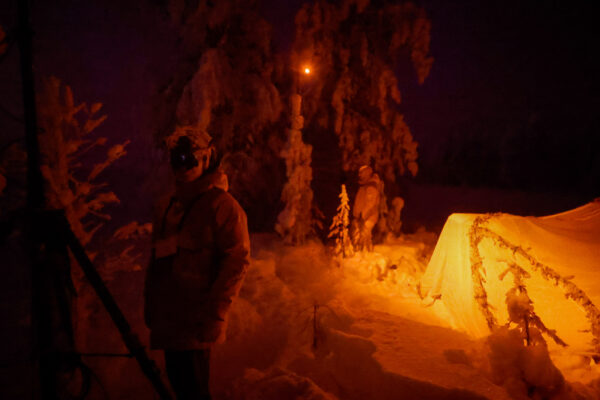
Base camp as seen through a Canon full-spectrum camera
The demonstration began at the Kemijärvi airfield after nightfall. Operators set up the surveillance mast deployment around 300 metres from the audience, near the treeline at the edge of the airfield. The base included the two Mastsystem tactical masts with Obsidian lights, a camo-netted snowmobile, a camouflage-protected firing position, a dome tent and four operators wearing helmet-mounted NVGs.
Phase 1: Direct comparison: standard IR vs. Obsidian
First, the sequence was built around direct comparison. First, a standard flashlight: immediately visible to the naked eye, NVGs, and camera. Then standard IR, clearly visible through NVGs and the Canon full-spectrum camera. When the standard IR was switched off, the audience learned the Obsidian lights had been running the entire time. Nobody had seen them.
Phase 2: Vehicle test: snowmobile with Obsidian light
Next, the second phase demonstrated the use of the Obsidian light as a vehicle light. Live camera footage showed a snowmobile departing from the base using a standard IR light, with the driver equipped with night vision devices. Observers could clearly see the snowmobile from 300 meters using night vision devices and the Canon camera. The snowmobile conducted tactical driving for approximately two minutes and arrived at the observation point, where the operator replaced the IR light with the Obsidian light.
The Obsidian light was easily visible near the observation point through night vision devices, but once the snowmobile had moved approximately 150 meters away, it disappeared completely from view. The snowmobile then drove back to the base along the same route, while the audience attempted to detect its position without success.
Phase 3: Walk-in inspection
In the final phase, the audience walked toward the base, stopping at approximately 100 meter intervals to check whether the base could be detected with night vision devices. The lights only became visible when the audience was approximately 100 meters from the base. At the base, the audience was able to inspect the Obsidian light, tripod masts, snowmobiles, and camouflage nets.
Demonstrations ran exactly as planned.
A few points stood out in particular:
– Defence professionals specifically praised the approach of presenting seven companies’ products as one integrated concept rather than isolated demos. The combination, limited signature IR on elevated masts, thermal camouflage, NVG-equipped operators, came across as a practical, deployable system, not merely a collection of products.
– The −30°C conditions were a genuine test. Mastsystem’s portable tactical mast systems received specific praise for ease of operation with thick gloves, low weight, and Arctic temperature performance.
What tactical mast systems mean for FOB procurement
Signature management at the tactical level is no longer optional. Mast systems and integrated signature management solutions must be tested under realistic conditions, not as isolated product specs reviewed in a conference room.
Mastsystem’s lightweight tripod masts fulfils the role that makes the rest of the system work: a man-portable platform that elevates sensors, lights, comms, or surveillance equipment to effective operational height without the logistic footprint of a vehicle-mounted mast. Furthermore, the same tripod that elevated an Obsidian IR light at GTD is able to carry an EW sensor, a communications antenna, or a surveillance camera at the next deployment. In short, with glass fibre composite construction qualified to environmental standards, Mastsystem tripods are not a niche product, they are a platform that integrates into any concealed base architecture. GTD validated that versatility under harsh Arctic conditions.
Finland’s approach combines Arctic-proof equipment, modular construction, dispersed operations, and whole-of-society mobilisation. As a result, it offers one of the more coherent national models for distributed, concealed base operations The technologies at GTD reflect that: practical, integrated and tested in the type of environment here they will be used.
Your next step: find the right mast configuration for your mission
Every concealed base, forward sensor position, and rapid-deployment communication node needs a mast platform. Mastsystem has delivered close to 40,000 mast systems to over 50 countries in more than 40 years, and our team configures every system to the specific mission requirement.
Whether you need a tripod mast for signature-managed base lighting, an elevated platform for EW sensors or surveillance cameras, or a vehicle-mounted tactical mast system for mobile communications, we will help you find the right configuration. In other words, our consultation and quotation process is driven by your operational requirements, not by a predefined product catalogue.
Request a consultation or technical specification from Mastsystem
Email: sales@mastsystem.com
Web: www.mastsystem.com
Obsidian™ limited signature IR light by Telva Oy:
Contact: Joe Pimenoff
Email: joe.pimenoff@telva.fi
Web: www.telva.fi/en | www.obsidiandefence.com
MADE TO STAND
Stay updated through our social media channels:


Contact us: mastsystem contact information | Mastsystem
